The modernization of the U.S. power grid requires a storage solution that is safe, cost-effective over a 20-year asset life, and manufactured at scale in the United States. At Ford Energy, we evaluated every commercially viable battery format against those criteria. We standardized our Battery Energy Storage System (BESS) architecture on lithium iron phosphate (LFP) prismatic technology because it delivers the lowest Total Cost of Ownership for grid-scale storage with no compromises on safety or reliability.
Why We Chose LFP Prismatic Technology
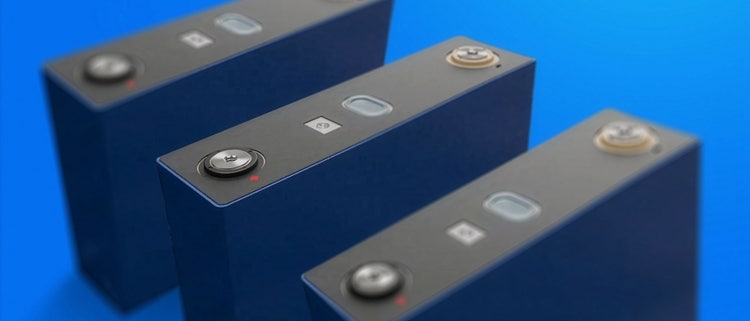
A Proven, Globally Dominant Technology
LFP prismatic is not an emerging chemistry. It is the dominant technology in grid-scale energy storage globally, accounting for 87% of worldwide installations in 2024, with hundreds of gigawatt-hours of cumulative deployed capacity.
That track record matters to project finance teams and independent engineers who require long-term performance data before committing capital. LFP prismatic provides it - thousands of cycles of documented stability, degradation curves validated across real-world deployments, and a safety profile unmatched by alternative chemistries. For lenders and investors, this is a bankable technology. For operators, it is a proven one.
Ford Energy selected LFP prismatic as the foundation for our entry into the stationary storage market, because the same attributes that make it the right choice for mobile applications make it the clear choice for grid infrastructure where availability and safety are non-negotiable.
Versatility Across Critical Infrastructure
Our 5 MWh+ DC container systems are engineered for the full range of applications our customers are deploying today:
- Renewable Firming: Managing the intermittency of solar and wind assets to deliver a steady, dispatchable energy profile.
- Grid Stability & Ancillary Services: Providing fast frequency response, voltage support, and spinning reserves to maintain reliability during peak demand.
- Data Center Resilience: Supporting the power requirements of AI and cloud infrastructure, including peak shaving.
- Large-Scale C&I: Enabling commercial and industrial operators to manage load growth, reduce demand charges, and ensure backup power for critical operations.
- Microgrids: Providing black-start capability and energy independence for remote industrial sites or campus environments.
Technical Advantage: Safety, Longevity, and Lowest Cost
For applications where uptime is revenue and unplanned downtime is unacceptable, LFP prismatic offers measurable advantages over Nickel Cobalt Manganese (NCM) chemistry, pouch cells, and cylindrical formats:
- Thermal Stability: LFP chemistry is inherently more stable than NCM, significantly reducing the risk of thermal runaway.
- Structural Stability: The rigid aluminum casing of a prismatic cell adds structural durability and reduces the thermal management infrastructure required - lowering both system cost and ongoing maintenance burden.
- Superior Cycle Life: LFP is structurally more stable over thousands of charge-discharge cycles than NCM, with prismatic LFP cells demonstrating up to 2.4x the cycle life of comparable alternatives. For a 20-year grid asset, this translates directly to lower degradation, fewer augmentation events, and lower lifetime cost.
- Highest Volumetric Packing Efficiency for Grid-Scale Applications: Among rigid cell formats deployed in containerized BESS, prismatic cells achieve approximately 72% volume utilization, minimizing wasted space and delivering maximum energy capacity within a standard 20-foot shipping container.
- Reduced Complexity and Fewer Failure Points: A lower total cell count per project requires fewer busbars and electrical connections than pouch cells, reducing assembly labor, minimizing potential failure points, and improving long-term system reliability.
- Lowest Total Cost of Ownership: LFP delivers the lowest battery pack cost of any lithium-ion chemistry in production – with a ~30% cost advantage over NMC. Combined with superior cycle life and reliability, this translates to the lowest Total Cost of Ownership for ESS developers - the metric that ultimately determines project economics.
Industrializing Storage at Scale
Our differentiation will be our ability to manufacture this technology at the volume and quality the market requires. We are applying more than a century of high-volume manufacturing discipline to battery energy storage - the same quality systems, supply chain rigor, and production engineering that Ford has built across decades of complex manufacturing.
“Our customers are not looking for a startup. They are looking for a partner with a balance sheet, a U.S. assembly capability, and proven production capability,” says Lisa Drake, President, Ford Energy. “We are developing a gigafactory for energy storage production in Kentucky – building domestic supply capacity for a globally proven technology at the scale this market requires.”
Assembled in America, Designed for ITC
Ford Energy will prepare our facilities in Glendale, Kentucky, to assemble LFP prismatic cells and modules. Combined with LFP production at BlueOval Battery Park Michigan, we are building a domestic supply chain that strengthens national energy security and positions our customers to meet domestic content requirements for Investment Tax Credit (ITC) eligibility.
For grid-scale storage - where availability, safety, and project economics are what matter - LFP prismatic is the technology. Ford Energy Battery Storage Systems are made in the USA from domestic and foreign materials.